Posts

Showing posts with the label HugoAward

Someone You Can Build a Nest In by John Wiswel

Image
  Someone You Can Build a Nest In by John Wiswell Themes:  monstrosity, identity, love, family, and trauma . Monstrosity and Humanity How does the novel challenge the traditional definition of a "monster"? In what ways is Shesheshen more human than some of the actual human characters, and vice versa? Shesheshen often describes humanity and human customs from a confused, alien perspective. What did these observations reveal about everyday human life and behavior? The narrative centers on a creature that eats people. How did the book successfully make Shesheshen a sympathetic protagonist despite her monstrous biology? Did you ever struggle to root for her? Do you believe Shesheshen has a moral code? If so, what is it based on, and how does it compare to the morality of the human characters? What purpose does the body horror serve in the story? Is it just for shock, or does it contribute to the broader themes of identity and connection? Identity, Shape, and Truth Shesheshen...

Babel by R.F. Kuang

Image
We are reading Babel by R.F. Kuang for April and May. We typically choose Hugo nominees and winners, but it seems obvious by this point that Babel should have been nominated if it weren't for the hanky-panky . A lot of people seem to have felt the same way, because there are several pretty good resources for book club questions:  Teatime Reads Duranoco Bookclubs.com Worlds Smallest Bookclub And there was a very lively discussion on Reddit

Translation Slate by Ann Leckie

Book Club Discussion Questions for Translation Slate by Leckie.  1. The Presger Translators are a VERY alien type of alien even though they have altered DNA and human mannerisms. What did you like about them? What did you find difficult to believe? 2. There are a number of very alien things in this book, from children eating one another to ship intelligences using humans as ancillaries, was there anything in particular that grossed you out or disturbed you? Anything you found particularly fascinating? 3. There are a lot of different pronouns used in the book and each group of people seem to use them differently; the Radch use “she” as a universal pronoun, the Presger Translators as a group seem to not consider gender at all and use “they” for everyone, etc. Did you find any of the ways pronouns were used to be interesting or jarring? 4. There are three Point of View characters, Enae, Reet, and Qven. Which do you find most interesting? Why? Were there other characters you ...

Starship Troopers by Robert A. Heinlein

Image
  January's Selection:  Starship Troopers by Robert A. Heinlein.  Reactor Magazine features a review . This one is an old favorite, and for better or worse, has influenced my political beliefs and voting choices. The terrible idea that really stands out to me, though, on this re-read is the defense of capital punishment. Heinlein overlooks so many problems with capital punishment, including, but not limited to the fact that not all murder cases are completely obvious to all who know the victims. Somehow, without a surveillance state, all authorities instantly know who is guilty. And this guilt has nothing to do with accents, race, ethnicity, or religious background.

Double Star by Robert A. Heinlein

A good critique of Double Star can be found on Reddit. The AI responses are popping up before I can even go looking for them. This is from Gemini (edited for clarity and accuracy).  For a book club discussing "Double Star" by Robert A. Heinlein, some key questions to consider could be: Character and Identity: How does Lawrence Smith's identity as actor shape his perspective and actions throughout the story? What are your thoughts on the concept of "doubling" and how it relates to Lawrence's role as a substitute for Bonforte? How does the story explore the idea of self-worth and personal agency, particularly through Lawrence's transformation into  Bonforte ? Plot and Themes: What are the key elements of the political intrigue in the story, and how does it influence the plot? How does Heinlein use humor and satire to explore the themes of political manipulation and the power of public perception? How does the nar...

Elizabeth Moon's _Remnant Population_

Image
  For September and October, we're reading Elizabeth Moon's Remnant Population .  I'm enjoying the story, but I couldn't think of questions to ask, so I let the AI, Claude, write questions for me.  I did adapt/correct some of the questions to be more accurate to the text. Here are some book club questions tailored to this specific book: Character: How does Ofelia's character evolve throughout the story? What drives her changes? What do you think about Ofelia's decision to stay behind when the colony leaves? Was it selfish or brave? Themes: How does the book explore themes of aging, independence, and self-discovery? What commentary does the novel offer on colonialism and its impact on indigenous species? Alien encounters: How does Moon portray the indigenous population? What makes their society unique? How does the communication barrier between Ofelia and the indigenes  affect the story? Society and culture: Compare the human colony's culture with that of...

2024 Best Novel (Hugos)

The 2024 Hugo nominated novels are  Best Novel The Adventures of Amina al-Sirafi by Shannon Chakraborty (Harper Voyager, Harper Voyager UK) The Saint of Bright Doors by Vajra Chandrasekera (Tordotcom) Some Desperate Glory by Emily Tesh (Tordotcom, Orbit UK) Starter Villain by John Scalzi (Tor, Tor UK) Translation State by Ann Leckie (Orbit US, Orbit UK) Witch King by Martha Wells (Tordotcom) I've read all the novels at this point. My favorite, and the one that is least like anything I've ever read, is Leckie's Translation Slate.  It has all my favorite themes, too. What does it mean to be human? And how does communication (or lack thereof) change the world. My second favorite is Wells' Witch King. Fantasy is not usually my thing, but this one was really interesting.  I enjoyed all the others, and I have to give a shout-out to The Saint of Bright Doors for about being an UNchosen one. That is refreshingly different. I'm not quite finished with it yet, so it ma...

The Saint of Bright Doors (July and August 2024)

Image
    The Saint of Bright Doors by Chandrasekera Reddit's 2024 Hugo Readalong: The Saint of Bright Doors, Vajra Chandraseker  Also from Reddit, a nice explication of the religious aspects of Buddhism that are embedded as well as some commentary on Sri Lankan politics and culture. Spoilery Review from Asking the Wrong Questions  Book review from Reactor.com  Another review from Every Book a Doorway Another spoilery review, that actually explains some of what's going on from Paige Reviews Books    Characters The Unchosen: Caduv (unchosen to be Singer of the Red), Koel (unchosen daughter of the Prophet of the Walking), Ulpe (unchosen of the Man in the Fire), Hejmen: Fetter's love interest.  Coema, Gerau, and Tomarin-- the committee who oversee Nine Yellow Oxen, the door that Fetter (as Peroe) studies.  Pipra-- the head of the group who studies the appearance of bright doors at the abandoned mall. (First Blue Heron is one of these doors) Janno...

Kaiju Preservation Society by John Scalzi

 For June, we are reading the always fun Kaiju Preservation Society. This is not a weighty book, but as Scalzi points out, 2020 was a dark time and the world needed more fun.  Resources for our discussion:  Tor offers a screening quiz to test if you are ready to join the KPS . And, as ReactorMag, they offer a nice review of the book .   Also, there are workplace guidelines for KPS.  Questions: What is Jamie Gray's gender? I've seen reviewers assume both male or female. "Jamie" is an ambiguous name, and the first person narration does not clarify.  Would you read a sequel?      Just for fun, I let Gemini write questions for me. I've listed them below, and it's likely that you'll spot some, ahem, issues with them: Kaiju Preservation Society Discussion Questions: Characters and Relationships: The novel features a quirky cast. How do the personalities of characters like Marvin, Hiro, and Jaime mesh (or clash) within the KPS? (Martin Satie, Tom...

Gideon the Ninth

Image
Resources for discussion of Gideon the Ninth by Tamsyn Muir Blurb:  The Emperor needs necromancers. The Ninth Necromancer needs a swordswoman. Gideon has a sword, some dirty magazines and no more time for undead nonsense.  Brought up by unfriendly, ossifying nuns, ancient retainers, and countless skeletons, Gideon is ready to abandon a life of servitude and an afterlife as a reanimated corpse. She packs up her sword, her shoes, and her dirty magazines, and prepares to launch her daring escape. But her childhood nemesis won't set her free without a service.  Harrowhark Nonagesimus, Reverend Daughter of the Ninth House and bone witch extraordinaire, has been summoned into action. The Emperor has invited the heirs to each of his loyal Houses to a deadly trial of wits and skill. If Harrowhark succeeds she will become an immortal, all-powerful servant of the Resurrection, but no necromancer can ascend without their cavalier. Without Gideon's sword, Harrow will fa...

A Memory Called Empire

Image
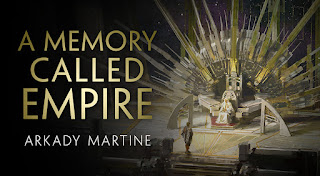
 For July and August, we'll be reading A Memory Called Empire, by Arkady Martine. This has been on my list since I saw Martine read at the Arkansas Literary Festival a few years ago.  Themes: Queerness Sacrifice  Culture Diplomacy Reviews:  Kirkus: https://www.kirkusreviews.com/book-reviews/arkady-martine/a-memory-called-empire/ Q&A with the author: https://www.npr.org/2019/04/07/710356506/questions-for-arkady-martine-author-of-a-memory-called-empire Vox: https://www.vox.com/culture/21497422/a-memory-called-empire-book-review

What We've Read So Far...

I wasn't keeping good records when we first started. I do have a list of books, but not exactly when we read them.  2015-2017   1953 Alfred Bester The Demolished Man (Hugo winner) 1961 Walter M. Miller, Jr. A Canticle for Leibowitz (Hugo winner) 1962 Robert A. Heinlein Stranger in a Strange Land (Hugo winner) 1964 Clifford D. Simak Here Gather the Stars (aka Way Station) (Hugo winner) 1966 Frank Herbert Dune (Hugo winner) 1967 Robert A. Heinlein The Moon Is a Harsh Mistress  (Hugo winner) 1968 Roger Zelazny Lord of Light  (Hugo winner) 1985 William Gibson Neuromancer  ( Hugo winner) 1970 Ursula K. Le Guin The Left Hand of Darkness  (Hugo winner) 1970 Kurt Vonnegut Slaughterhouse-Five (Hugo nominee)  1976 Joe Haldeman The Forever War  (Hugo winner) 1982 C. J. Cherryh Downbelow Station (Hugo winner) 2002 Neil Gaiman American Gods (Hugo winner) 2012 Jo Walton Among Others (Hugo winner) 2013 John Scalzi Redshirts  (Hugo wi...